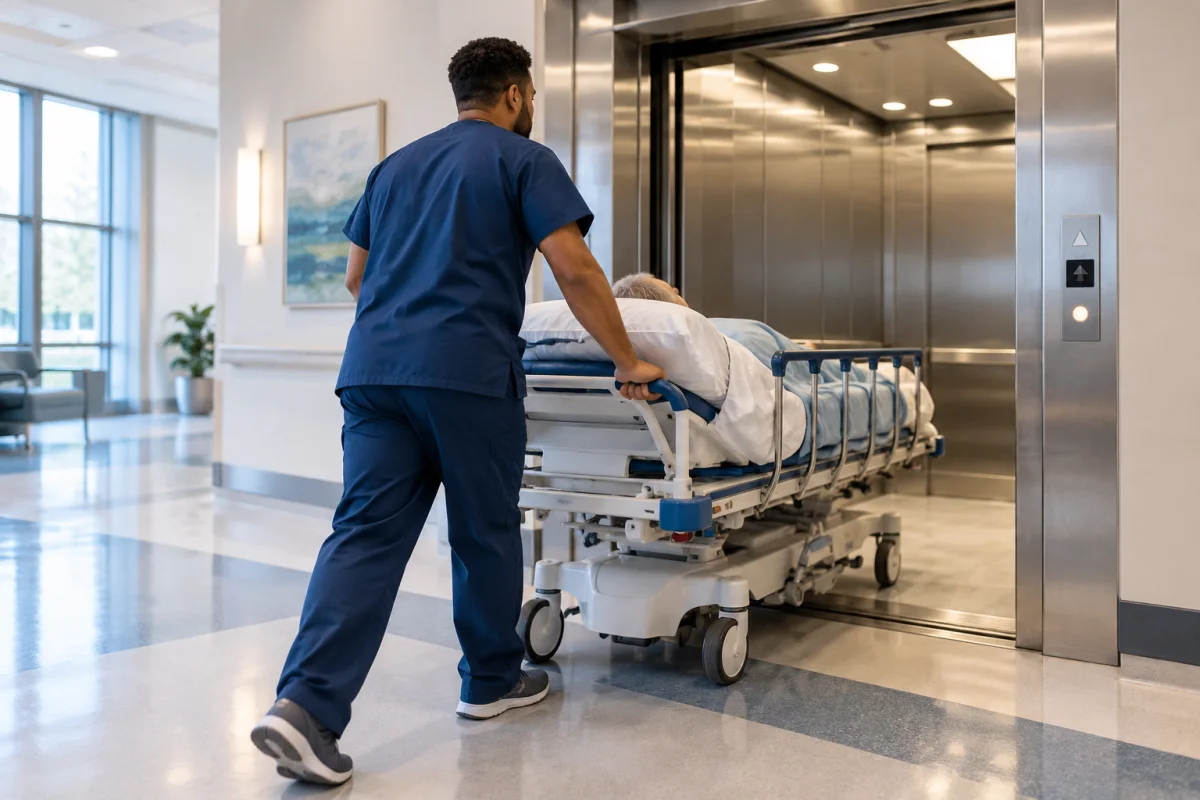
Every patient move has two parts: the handoff at each end and the trip in between. Most training focuses on the handoffs, but the hallway and the elevator are where a transporter spends most of the trip. Busy corridors, blind corners, crowded elevators, and heavy doors all add risk for the patient and for you. This guide covers practical habits that help new and experienced transporters keep every trip safe and calm.
Why the Trip Itself Deserves Attention
Hospitals are busy workplaces, and injuries happen. According to the Bureau of Labor Statistics, employers in the health care and social assistance sector reported 3.4 injury and illness cases per 100 full-time workers in 2024. Not every one of those cases happens in a hallway, but many everyday transport risks, like collisions, pinched fingers, and strained backs from pushing awkward loads, start there.
The good news is that most of these risks can be reduced with simple, consistent habits.
Check Your Equipment Before You Move
A safe trip starts before the wheels turn. Before every transport, take a few seconds to check the basics your department trains you on:
- Brakes lock and release smoothly.
- Wheels roll straight and do not stick or wobble.
- Side rails, footrests, and safety belts are in place as your facility requires.
- Attached equipment, like IV poles or oxygen, is secured according to policy.
If anything is broken or missing, do not work around it. Swap the equipment and report the problem so the next transporter does not run into it. Always follow your facility's policy for equipment checks and anything attached to the patient.
Hallway Habits That Prevent Collisions
Corridors are shared with staff, visitors, carts, and other transports. A few habits make a big difference:
- Keep to the right, just like on a road, unless your facility uses a different rule.
- Slow down at corners and intersections. Pause, look, and announce yourself if you cannot see around the turn.
- Position yourself the way your department trains, so you can see where you are going and still keep an eye on the patient.
- Keep a safe speed. A steady walking pace is safer and more comfortable for the patient than rushing.
- Watch the floor. Wet floor signs, cords, and spills are reasons to slow down or choose another route.
Talking to the patient helps too. Let them know when you are about to turn, stop, or go over a bump. People feel safer when they know what is coming.
Elevator Safety Basics
Elevators are one of the most common pinch points in any transport. Use these habits every time:
- Hold the door open with the door control, not with your body or the stretcher.
- Enter and exit carefully, checking that the floor of the elevator lines up with the hallway floor.
- Position the patient so you can see their face and reach the controls.
- Use the hospital's priority or service elevator when policy calls for it, especially for patients who need privacy.
- If the elevator is crowded, wait for the next car. Squeezing in puts the patient and other riders at risk.
Some patients feel anxious in tight spaces. A calm voice and a simple explanation, like "We're going up two floors and then straight to imaging," go a long way.
Protect Your Own Body
Your safety matters as much as the patient's. Pushing and steering heavy equipment all shift adds up.
- Push rather than pull whenever you can.
- Keep your back straight and use your legs to get a heavy stretcher or bed moving.
- Ask for help with heavy, bariatric, or hard-to-steer equipment instead of forcing it.
- Use powered transport equipment if your department has it and you are trained on it.
If you feel pain or strain, report it right away according to your department's process. Small injuries are easier to address early.
Know When to Stop and Get Help
Transporters are often the only staff member with a patient between units. If the patient's condition seems to change, or something feels wrong, stop in a safe spot and get help following your facility's policy. Your job is not to provide clinical care. It is to notice, keep the patient safe, and alert the right people quickly.
Build Safe Habits That Last
Safety habits stick best when they are taught the same way to everyone. The Certified Healthcare Transporter (CHT) credential gives transporters a shared standard for safe handling, communication, and patient experience. Departments that want to teach these habits in-house can train their own instructors through the Certified Healthcare Transporter Instructor (CHTI) program.
A safe trip rarely gets noticed. That is the goal. When every hallway and elevator ride is calm and uneventful, patients arrive ready for care, and you finish your shift ready for the next one.
Sources
- Bureau of Labor Statistics, Employer-Reported Workplace Injuries and Illnesses, 2023-2024: https://www.bls.gov/news.release/osh.nr0.htm